Wars, interminable lines at airports, unbearable heat in the West, continued chaos at the Kennedy Center, and so much more. What can we do to alleviate some of this tension? And how fortunate are some of us to be able to bring solace and comfort through music?
March turned out to be an extraordinary month full of wonderful surprises and memorable moments. At first, I was dreading this nine-week European tour without a meaningful break between engagements. The trip comprises eight countries and seven different languages, if you count the Scottish dialect. Fortunately, I am giving repeat performances of several works over this timeframe and only conducting two pieces that are new to me.
I have put a new paradigm in place for future travel. With my new position in Nashville taking up several weeks of the season, I am limiting my adventures abroad to just four weeks at a time, usually with a full week off before and after the trip. Following this current tour, I will not go overseas until October, but unless the government figures out how to fix things, being at the airports may be just as grueling.
First up was Warsaw. I last worked with the Warsaw Philharmonic three years ago when we presented the Missa Solemnis as part of the Beethoven Festival. During the performance, the concertmaster snapped a string and quickly exchanged it with his colleague, never missing a beat of the extended solo.
This time, we performed an all-orchestral program, the first of three engagements in a row without a soloist. Not that the conductor can relax during a concerto, but depending on the work, it can offer a bit of respite because the heavier burden falls on the featured artist. The main attraction was the Second Symphony by Rachmaninov, a work I have performed possibly more than any other in my entire career but never with this orchestra.
With a warm, rich string sound, fantastic solo clarinet playing, and excellent attention to detail, this was one of the most satisfying performances in which I have ever been involved. It helped immeasurably that the hall had very warm acoustics, and we could achieve ideal dynamic balances. The audiences of the two sold-out concerts could not have been more enthusiastic.
The program began with the European premiere of my Schubertiade. Again, aided by a superb sonic environment, the piece sounded lovely. There was one snarky critic who commented that the work was “harmless.” I wonder what would constitute a “harmful” piece?
Copland’s Appalachian Spring Suite was new to the Warsaw Philharmonic, and it took a while for everyone to get into the correct spirit. Some styles are difficult to explain with words, so I wind up singing how certain passages should go. Everyone eventually got the idea, despite the tricky rhythms and almost Mozartian details in this suite. Thankfully, we had enough rehearsal time to revisit the piece a few times and allow it to settle. The result was an idiomatic and moving performance.
Poland has a special meaning for Cindy. She studied with Krzysztof Penderecki in Krakow and tutored his two children in English. We have both visited the country several times, and next season, we will return to Katowice. Musical values remain high in this storied country.
Ever since Franco’s death, Spain has been revitalized in many ways. The incredible growth of its orchestras is just one of the diamonds in the cultural crown. Having conducted in many cities in the country throughout my career, I was surprised to learn of an orchestra I didn’t know, considered by many to be the very best of the lot.
The Franz Schubert Filharmonia was founded twenty years ago by conductor Tomàs Grau. It is based in Tarragona, about an hour’s drive from Barcelona. The average age of its musicians is thirty-eight, but they play like a much more experienced ensemble. I accepted this engagement based on recommendations from others who have worked with the orchestra and am very glad that I did.
Tarragona is one of the oldest cities in the world, as evidenced by the ancient Roman ruins, many of which are very well-preserved. As part of Catalonia, the city reflects a strong sense of independence, but not quite enough to fuel a true separatist movement. It has become a destination spot for tourists and a stop on many cruise itineraries.
Since I was working with this orchestra for the first time, I put together an approachable program, although it was still challenging in many ways. By some measures, this is the least “Slatkin-like” repertoire of the season because aside from Barber’s Adagio for Strings, the works on the program are not often found on my concert calendar.
Always among my top ten favorite symphonies, the Great C Major by Schubert made sense, not only because the orchestra bears the composer’s name but also because they had not played it for several years. Robert Schumann once remarked on its “heavenly length,” as it comes close to lasting for an hour. The conductor must come to grips with a multitude of decisions about repeats, accents, and other markings. (For those interested, no repeats for the first movement, the first repeat in the trio but not the second, and none in the finale.)
This orchestra offered so many moments of beauty and pleasure, including wonderful solos from the horns, oboe, and clarinet as well as sensitive string sonorities featuring a wide range of dynamics. Even with the hall’s dry acoustic in Tarragona, the overall sound seemed to carry well enough. Although it is exhausting, this symphony also provides a feeling of exhilaration and accomplishment at its conclusion.
Coincidentally, that very morning, the Barcelona Symphony, conducted by Juanjo Mena, presented the same Schubert symphony. I wonder how many people heard both performances.
I have recorded the last twelve symphonies by Franz Joseph Haydn and can never get enough of this composer. His works are far more difficult to perform than Mozart’s, perhaps because they are not as well known by the musicians these days. At one time, they were standard repertoire for any major symphony orchestra.
We performed the 94th of Haydn’s 104 numbered works in the form. Called the “Surprise” in English, it is known in German as “Mit dem Paukenschlag,” or “with the drumbeat.” However, this symphony provides more surprises than just the loud chord near the start of the second movement. In fact, it is difficult to find any Haydn symphony that does not contain something new to startle the musicians and audience.
The Filharmonia displayed a true sense of style during the rehearsals and performances. We did not indulge in “historically informed” practice but rather played in a way prevalent in the middle of the twentieth century. You could taste the joy on the orchestra’s musical palate.
After the first performance in Tarragona, we all traveled to Barcelona to give the program a second go in the historic Palau de la Música Catalana. This marvelous building has some of the most astonishing interiors of any concert hall in the world. The acoustics are warm and generous, perfect for our program.
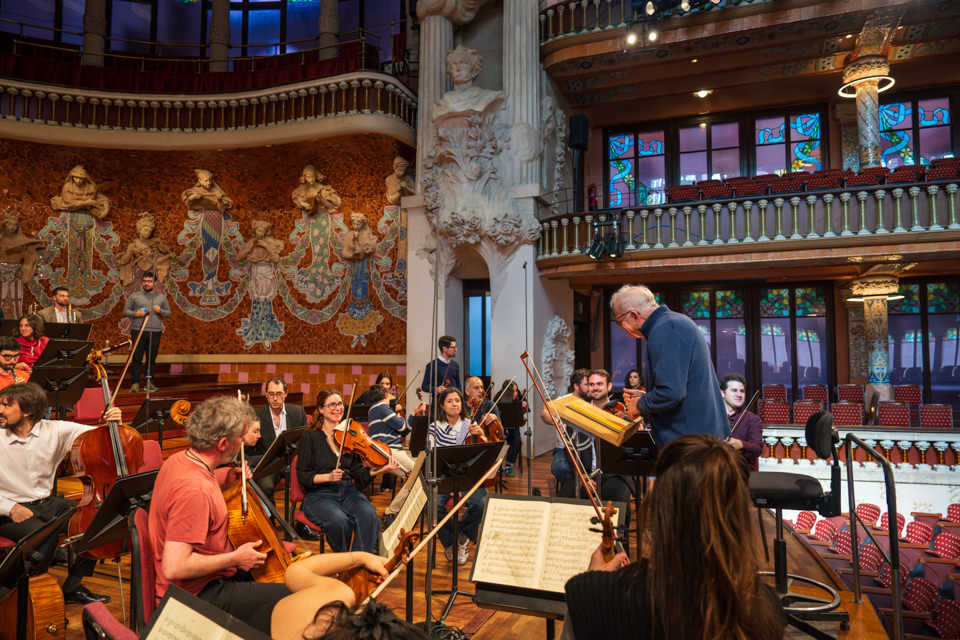
All my best wishes for this orchestra and Maestro Grau as they proceed forward. If any of you find yourselves nearby, do not miss the opportunity to hear this wonderful ensemble.
The month ended with a homecoming of sorts. I returned to Lyon, where I spent six memorable seasons as music director between 2011 and 2017. I look back on those years as some of my very happiest times, filled with satisfying recording projects and successful tours. Reuniting with the orchestra is always a pleasure.
The program was not particularly demanding in terms of stamina, unlike the first two on the tour, but it contained one major curiosity for the musicians requiring a lot of preparatory work.
With only one exception on this trip, I am conducting at least one American work on each program. In Lyon, we presented two. Bernstein’s Candide Overture always makes a great opener, and the French connection with Voltaire gave it a special meaning. But the next piece, Copland’s Billy the Kid, was more of a departure for this ensemble. It seems that they had not played a note of it, much less the entire ballet, since I conducted the suite there back in 2017. Unlike the more familiar Appalachian Spring, this portrait of the American West felt like uncharted territory. I spent a few moments explaining the story, and then we got to work.
At first, I think the ensemble was a bit disoriented by the folksong references and some of the stylistic elements, including the gunfight sequence, which took time to coordinate. However, since many members of the orchestra knew me, we had little difficulty getting our old sound back.
The orchestra is now positioned differently onstage, with antiphonal violins and basses to the left. This takes some getting used to in the spacious confines of the hall, but once I found my footing, most everything came together. By the time we finished rehearsals, I told everyone that they were now honorary cowboys. We just needed hats and boots to complete the transformation.
If Rachmaninov’s Second Symphony qualifies as the one I have performed the most often, certainly Dvořák’s “New World” is a close second. Since I always send the master copies of the string parts, all bowings and phrasings are put into the orchestra’s set, and we do not have to spend time on what can be a cumbersome task during rehearsals. In other words, we get right down to the music-making.
I wonder what younger members of the orchestras with which I have a long history think of the efficient way in which I rehearse. I take a concise approach and try not to waste time with lengthy descriptions. I rely instead on my gestures, which hopefully convey the essence of what I wish to accomplish. In the end, it usually turns out just fine.
Seeing my old friends in the orchestra and audience made for a delightful end to the first third of this long trip. I will have more stories to share in the next installment of the journal, so do check in every so often. Additionally, you can find new content on the various social media platforms I use, including album covers, news from Nashville, and Instagram photos, some of which I have no idea how they get there.
See you next month,
Leonard