Not much happened in February. Oh, wait. There were a couple of things.
Let’s start with the announcement of my new position as music director of the Nashville Symphony. This past summer, I was named artistic advisor, but as we reviewed the scope of the ensemble’s activities in Music City, it became clear that a more active role for me was needed.
The contract is for three years, at which point I will be approaching my 85th birthday. Hopefully, both my body and brain will still be intact, as this is a very big job. When I left Detroit, I swore that I would never take on the role of administrator again. After serving as a music director for more than 40 years, the guest-conducting circuit seemed more conducive to my lifestyle.
With the Las Vegas consultancy behind me, I started to remember why I ran orchestras for all those years. I missed the puzzle-solving part of the business and the close connection with one group of musicians.
The orchestra grew tremendously under Giancarlo Guerrero, and we will continue to build on that momentum. We announced next season’s offerings at the end of the month, and initial responses to the renewal campaign have been very promising. One of our initiatives is to recognize and promote individual members of the orchestra as stars in their own right. Many of them will appear as soloists during the season.
I will finally get to record David del Tredici’s Final Alice with soprano Hila Plitmann in January. This has been a bucket-list item because the only commercial recording of the piece dates back to 1980 and omits about twelve minutes of astonishing music. Next season’s performance will be a multi-sensory experience featuring projected set design and other enhancements to create an “Alice in Nashville” concept.
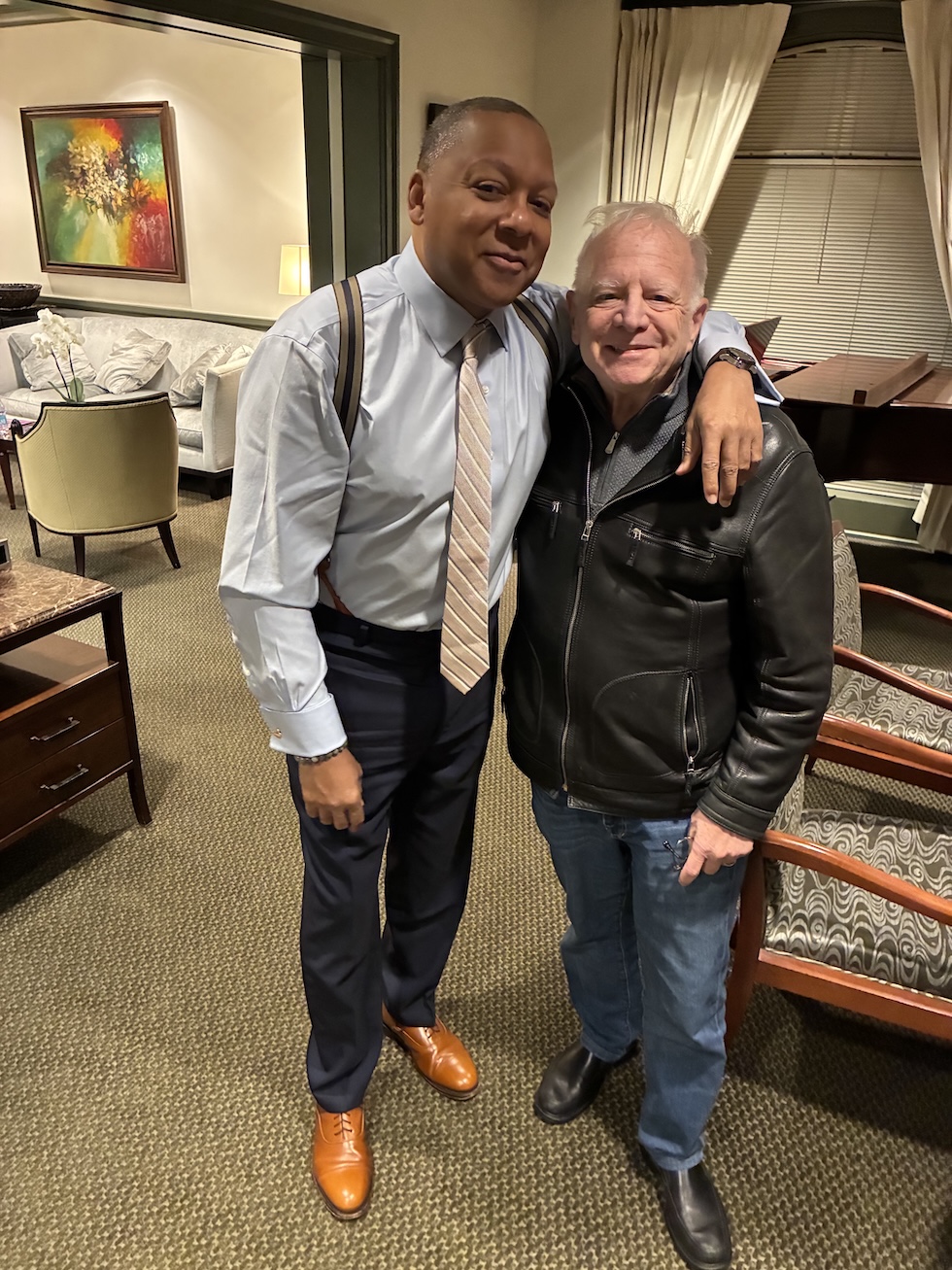
While I was in Nashville for the announcement, Wynton Marsalis brought his Jazz at Lincoln Center orchestra to town. What a great band! It was wonderful to catch up with him and talk about our lives.
A few days before this, Cindy and I headed to NYC as part of an entourage for the Budapest Festival Orchestra, which gave two concerts at Carnegie Hall. We took in the always engaging Mahler Third Symphony, which was brilliantly played and conducted. Ivan Fischer and I had lunch together that very day, and I was worried that after two hours of dining and chatting, he would be too exhausted for the performance. Although we had not really had an opportunity to get to know each other until recently, we share a commonality in our relationship with the National Symphony Orchestra.
This, of course, brings me to the downer of the month, artistically: On the evening of the Grammy Awards, February 1, out of nowhere, a posting on Truth Social read, “I have determined that The Trump Kennedy Center, if temporarily closed for Construction, Revitalization, and Complete Rebuilding, can be, without question, the finest Performing Arts Facility of its kind, anywhere in the World.” The president went on to write, “Financing is completed, and fully in place!”
The very next day, the president offered some clarification. Supposedly, the center will not be torn down, raising the issue of why they cannot selectively work on one part of the building while others remain open. This is what occurred when the NSO moved out of the concert hall for renovations and performed in the Eisenhower Theater instead.
Most troubling is what happens to all those employees who will be out of work during this time. Here is what is at stake for the National Symphony Orchestra, which became an artistic affiliate of the Kennedy Center in 1986 and has performed there since 1971.
The orchestra will have to find new venues to perform in for the duration. That means they need to rent the spaces, something they do not currently have to do. What about stagehands and staff? Where will their offices be, and who pays for them?
Where can the orchestra relocate? Not Strathmore Hall in Bethesda, Maryland—no room at the inn. This is the Baltimore Symphony’s secondary home and features other attractions throughout the year. Can the NSO return to DAR Constitution Hall? It’s possible, but it doesn’t have a particularly good acoustic.
Keep in mind that orchestras plan their seasons two years in advance. Even though they have not announced their schedule starting in September, almost every orchestra concert has already been programmed, with dates set for soloists and conductors. The usual season rollout for the entire center typically happens in early April. Now all that planning must be postponed until venues are secured and finances are clearly defined.
My heart breaks for my colleagues. Several I have spoken with simply do not know whether they will have jobs the next time they show up at the KC. How do you perform with the sword of Damocles hanging over your head?
Their outstanding music director, Giandrea Noseda, is in an impossible position. His contract was just extended until 2031. The orchestra cannot possibly grow in its abilities without a permanent home. All the hard work over the past years will suffer. Some members will seek employment elsewhere or retire early.
What can an individual artist do under these circumstances? Sadly, not much. We are just hired help, subject to the whims and wills of others. Making music at the highest possible level sounds good, but it really does little to move the sticks forward. Maybe we should remind the KC board and Congress what President Kennedy had to say, as inscribed, for the time being, on the Kennedy Center’s wall:
There is a connection, hard to explain logically but easy to feel, between achievement in public life and progress in the arts. The age of Pericles was also the age of Phidias. The age of Lorenzo de Medici is also the age of Leonardo da Vinci. The age of Elizabeth also the age of Shakespeare. And the new frontier for which I campaign in public life, can also be a new frontier for American art.
However, it looks like the board of trustees is more interested in having The Sound of Music as the first production in the reinvented center. More likely, it will be “The Sounds of Silence.”
***
I had some conducting to do in February, but it was relatively calm because an enormously taxing schedule starts this month.
The Orchestre symphonique de Montréal is among the most distinguished of Canadian ensembles, and it had been many years since I performed with them. I only knew a few members of the orchestra, having worked with them in other places.
The program was lovely and quite pleasant to conduct. Tchaikovsky’s First Symphony does not come up very often, and I had only conducted it twice previously. The composer’s first three works in that form exhibit his remarkable affinity with the Romantic style prevalent in Europe at the time. Remember that Russia had no tradition for this type of composition. Tchaikovsky would go on to refine it, producing the masterpieces of his fourth, fifth, and sixth symphonies.
There are so many delights in this symphony, also known as “Winter Reveries,” from the ice of the first movement to the heroic moment in the second when the horns blaze forth with a very Russian melody. The Scherzo takes us to the world of ballet before the virtuosic romp of the Finale.
This engagement also provided an opportunity to revisit a piece by an American composer who left the States during the Vietnam War and relocated to Toronto. Michael Colgrass was so gifted, with an incredible ear for color. His “As Quiet As” takes its title from an assignment handed out to a fourth-grade class. The students were asked to finish the sentence, “Let’s all be as quiet as _____.” Among the seven short pieces are answers such as “an ant walking,” “a star coming out at night,” and “a leaf changing color.”
It is a brilliant piece of writing and should truly be part of the repertoire. With the various tensions between the United States and Canada, I thought this could go a little way toward temporarily healing the rift. However, with new tariffs in place, I was concerned that the orchestra might take 10% off my fee.
The soloist was the homegrown pianist Angela Hewitt. A Mozart specialist (although she does have a much broader repertoire), she performed the big D-major concerto, “Coronation.” The first time I conducted it, the soloist was my conducting teacher and all-around mentor, Walter Susskind.
The Montreal Symphony has always enjoyed a justly deserved fine reputation. It performs in La Maison symphonique de Montréal, an excellent, warm facility. This was my first time in the hall, and if some of you are wondering, I spoke both French and English during rehearsals. The musicians were a delight to work with, and they sound terrific.
***
I have saved the best item of the month for last.
Out of the blue, I received a message from a good friend, Robert Gilson, with whom I went to junior high school. It seems that our orchestra conductor from back then, Eileen Wingard, now 96, was giving a presentation on Jewish conductors. I had not spoken to her for many decades. Mrs. Wingard—I can never call my teachers by their first names—was among the finest people to help guide me in my early years.
We arranged for Bob to call me, and before I knew it, I was put on speaker phone for a conversation that went something like this:
Mrs. Wingard: “Hello?”
Me: “Is this Eileen Wingard?”
Mrs. Wingard: “Yes.”
Me: “Is it true that you gave Leonard Slatkin his first opportunity to conduct?”
Mrs. Wingard: “Yes. It was the Morton Gould Pavane.”
Me: “In that case, I would like to thank you for jump-starting my career. This is Lennie.”
How I would have loved to do that in person. As I told her and the group, there is no more noble profession than teaching. She inspired generations of young people, a few of whom went on to become musicians. Her ability to find ways to bring disparate individuals together through music is rare and beautiful.
I do hope to see her on my next visit to the West Coast.
Oh, I also mentioned that day when we tried to lock her in the double-bass cabinet. But that is a story for another time.
See you next month,
Leonard